OpenBusiness by Tradebook
Product
Cleaning and facility management

Staffing contracts by site, special services, supplies at cost, AIU and per-worker annex.

SCPEAB
Private security

Staff per post with surcharges, uniforms and PPE with signed records, training with expiry dates.

SCPEFI
Temporary staffing and outsourcing

Workers on assignment, pre-invoice per worker, electronic payroll and PILA costed to the client.

PESCFI
Distribution and consumer goods

Routes and collections with Trade360, inventory movement records per warehouse, filling and packing, catch weight, batch labels.

COABSC
Retail, stores and restaurants

Point of sale with electronic POS document, online store, marketplaces and inventory.

COABFI
Importers and trading companies

Import and export checklists, import declaration costs included in inventory and foreign currency operations.

ABFICO
Manufacturing and industry

Recipes and bills of materials, production orders, actual cost, make-to-order, purchasing and batches.

ABPEFI
Technical service and maintenance

Field work orders with forms and evidence, support with agreed response times and spare parts tracked in inventory.

SCABCO
Government contractors and suppliers

Contracts with Colombia’s SECOP II procurement platform, adjustments based on inflation, minimum wage or tax units, agreed service times, insurance policies and document history.

SCFIPE
Agribusiness

Harvest or livestock intake with weighing, quality and settlement; batches and traceability; field staff.

SCPEAB
Food and beverage

Batch recipes, signed critical control points, traceability to origin, catch weight and harvest settlement.

ABFICO
Chemicals, cleaning products and cosmetics

Percentage formulas with versions, pH and viscosity as critical points, health notification and data sheets.

ABFICO

Recommended suites:COSalesSCServices and ContractsABSupply and ProductionFIFinancePEPeople
Sector pack · Canned tuna

Production for canned tuna Three signed critical control points, quarantine until sterility and the per-lot record the regulation requires

The canning pack gets the plant ready: catch intake by vessel and trip with histamine, temperature and certificates, cleaning as a breakdown into loin, flakes, meal and oil, canning with critical control points for cooking, double seam and sterilization (minimum F0 lethality of 3), incubation with the lot in quarantine until the commercial sterility test, can and case labels, and the critical control point record per lot in Excel or PDF.

Back to Production

Tuna canning plant with retort, filling and seaming line, and an operator recording the F0 value of a load on a tablet

Who it is for

  • ✓Fish canneries that receive by vessel and must control histamine and temperature from intake.
  • ✓Companies with a hazard analysis and critical control points (HACCP) system that need the cooking, seaming and sterilization record per lot, signed.
  • ✓Plants that keep the lot in quarantine during incubation and cannot ship without commercial sterility.
  • ✓Exporters and suppliers to large retail chains that need traceability from the can to the vessel and barcode labels.

The plant's process, step by step

From the vessel to the can, every step happens on a Production screen and leaves its lot, its cost and its evidence.

  1. Intake by vessel

    The lot is vessel plus date, species and size. The catch-type receipt records weight, temperature (around −18 °C), histamine and the catch certificates, with the vessel taken from the supplier card (registration number, flag and certificates). The catch intake table deducts or rejects according to histamine and temperature.

  2. Tank lots

    When deliveries are blended in a tank, the child lot keeps the share of each parent and inherits the most restrictive status. The traceability of the can reaches each vessel.

  3. Cooking

    First critical control point (CCP): backbone temperature between 60 and 70 °C. The operator records it and signs at the terminal.

  4. Loin cleaning

    The cleaning recipe is a breakdown: from 1,000 kg of whole tuna come cooked loin 45% (main product), flakes 10% (co-product by relative sales value), fish meal 35% and fish oil 10% (by-products at net realizable value). The cost is allocated and the by-products do not inflate the loin.

  5. Filling and double seam

    The canning recipe is a formula: loin, vegetable oil as the packing medium, sea salt and a 185 g can. The second critical control point is a conforming double seam on the can.

  6. Retort sterilization

    Third critical control point: the F0 lethality of the load must be at least 3 and the retort temperature at least 116 °C, with the retort operator's signature. If a load reads F0 2.5, the can lot is held.

  7. Incubation and commercial sterility

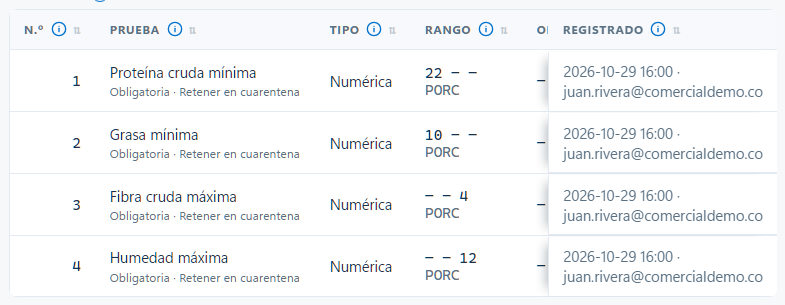
    The can lot is born in quarantine and the commercial sterility inspection becomes available after 10 days of incubation, with product histamine below 100 mg/kg. Only then does quality release the lot with its certificate of analysis (COA).

  8. Labeling and packing

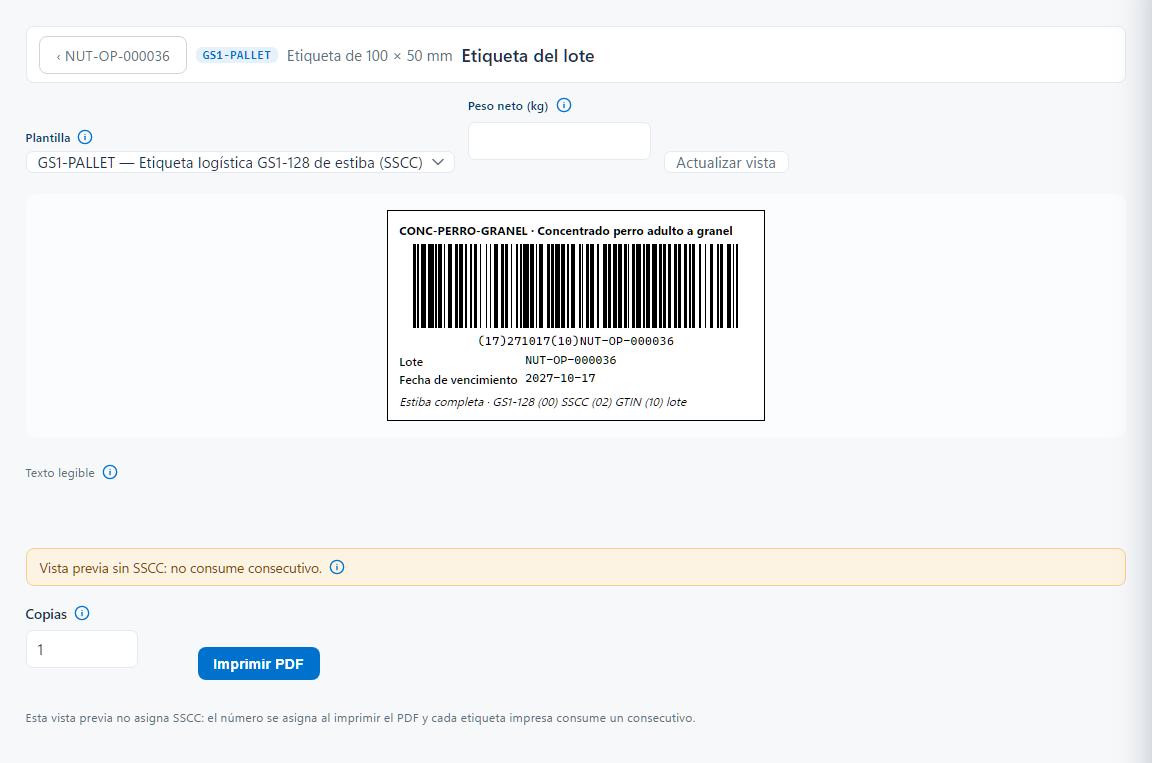
    Can label and 48-can case label with lot, expiry and sanitary registration, as a GS1-128 barcode with the unique code of each case or pallet.

  9. Critical control point record per lot

    The monthly report gathers lot, product, date, F0, temperature, double seam, compliance and who signed, in Excel or PDF, ready for the audit or the health authority.

What the pack installs

01Products and units

Whole frozen yellowfin tuna, cooked loin, flakes, fish meal and oil, vegetable oil, sea salt, 185 g can with lid and tuna in oil in a 185 g can, with seven categories.

02Catch intake table

Histamine and arrival temperature with deduction or rejection ranges editable by the plant, plus the F0 value and can vacuum parameters for the process inspections.

03Six work centers and the canning routing

Receiving and thawing, cookers (tank), loin cleaning, filler and seamer, retort (tank) and incubation room. The routing runs through cooking, cleaning, filling, seaming, sterilization and incubation.

04Two template recipes

Whole tuna cleaning (breakdown with co-product and by-products) and 185 g tuna in oil canning (formula).

05Three critical control points and sterility

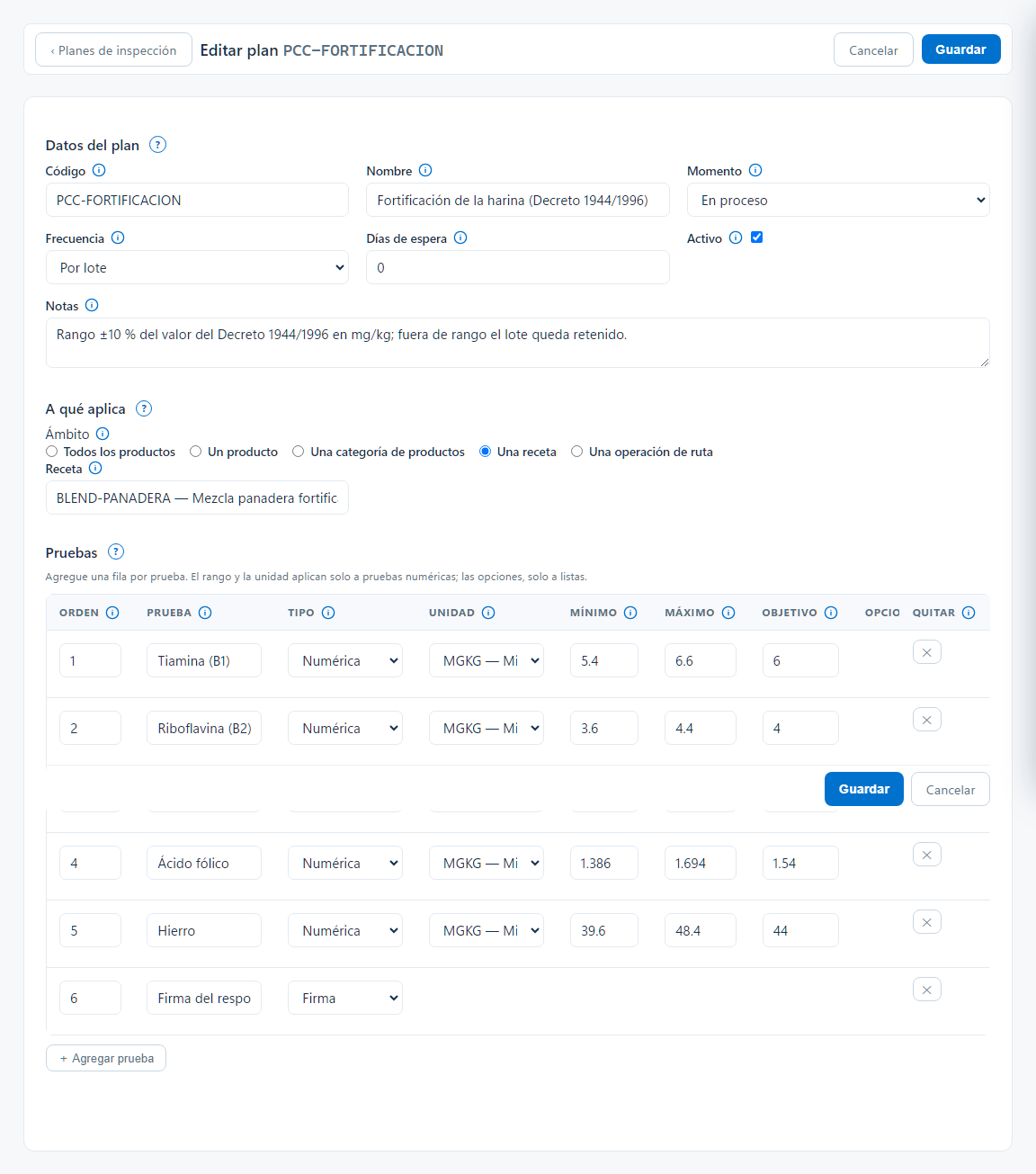
Critical control point (CCP) plans for cooking (60 to 70 °C), double seam and sterilization (minimum F0 of 3, minimum temperature 116 °C, signature), plus the commercial sterility inspection of the finished product with maximum histamine of 100 mg/kg.

06Quarantine for incubation

The can lot is born in quarantine and the release inspection waits for the incubation days configured in the plan.

07Critical control point record per lot

Report of the critical control points per lot with F0, temperature, double seam, compliance and signer, in Excel or PDF.

08Can and case labels

Can label and 48-can case label with lot, expiry and sanitary registration as a barcode.

09Plant terminology

"Vessel lot", "Catch" and "Blend tank" on the screens.

10Demo data

The vessel "Don Pedro" with its registration number, an INVIMA sanitary registration for the product with its validity (INVIMA is the health regulator) and stock to walk through the full scenario.

Case

Example: a retort load with low F0

Figures from the demo company, as they appear on the screens.

5,000 kgof tuna received from the vessel Don Pedro
40 mg/kghistamine at intake: no deduction
F0 2.5on a retort load, below the minimum of 3.0: can lot held
300 cansin a closed canning order
COP $1,199,799.99actual cost of that order

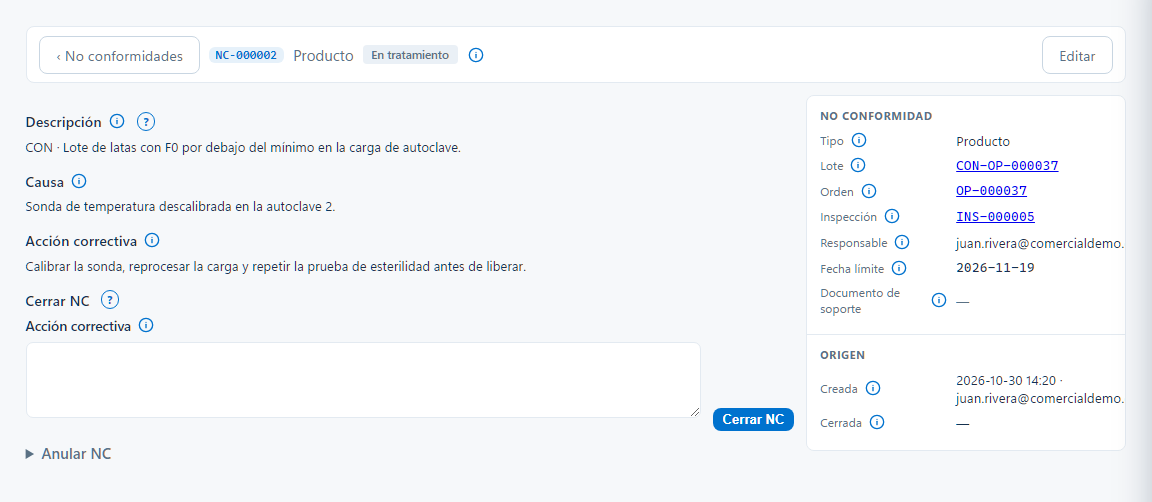
The low-F0 load left a rejected inspection, the lot in quarantine and a nonconformance with the cause (probe out of calibration) and the action (calibrate, rework and repeat the sterility test). The following month the nonconformance is closed and the lot is released with its certificate of analysis. The critical control point record per lot shows the rejected load and who signed.

Regulations it covers, and how

Resolution 776 of 2008 (amended by 122 of 2012): histamine and commercial sterility

Average histamine below 100 mg/kg and canned products with commercial sterility verified by incubation. The intake table controls the fish's histamine, the finished product inspection controls the product's, and the lot waits in quarantine for incubation.

Decree 60 of 2002: HACCP system

The hazard analysis and critical control points (HACCP) system requires a record of every critical control point (CCP) per lot (cooking, seaming, sterilization). Every order generates its critical control point inspections with values and signature, and the critical control point record per lot is generated in Excel or PDF to be filed.

Resolution 148 of 2007: technical regulation for canned tuna

Product requirements, labeling and lot control: can and case label with lot, expiry and sanitary registration, and a lot record in PDF.

Resolution 719 of 2015: risk classification

Canned fish is high risk and carries an INVIMA sanitary registration (INVIMA is the health regulator). The registration is kept with its validity, linked to the product and to the formula version, and the system alerts before it expires.

Connected with the rest of OpenBusiness

Intake, cleaning and canning touch purchasing, inventory, quality, accounting and sales without anyone typing twice.

  • ✓The catch settlement creates the purchase invoice to the vessel owner with the weight and the table's deductions.
  • ✓The can lot is born in quarantine in Inventory and its card shows the quality strip; nobody ships it until sterility is confirmed.
  • ✓The certificate of analysis and the catch certificates are filed in the lot record, in Document management, with electronic signature of the inspections if you use it.
  • ✓Forward traceability reaches from the fish lot to the can lots and to the customers by delivery note; the recall simulation is saved as evidence.
  • ✓Every order leaves its consumption, labor, overhead and completion in accounting with cost allocation among loin, flakes, meal and oil.
  • ✓An automation flow holds the lot and alerts quality when a critical control point goes out of range.

Your plant at a glance

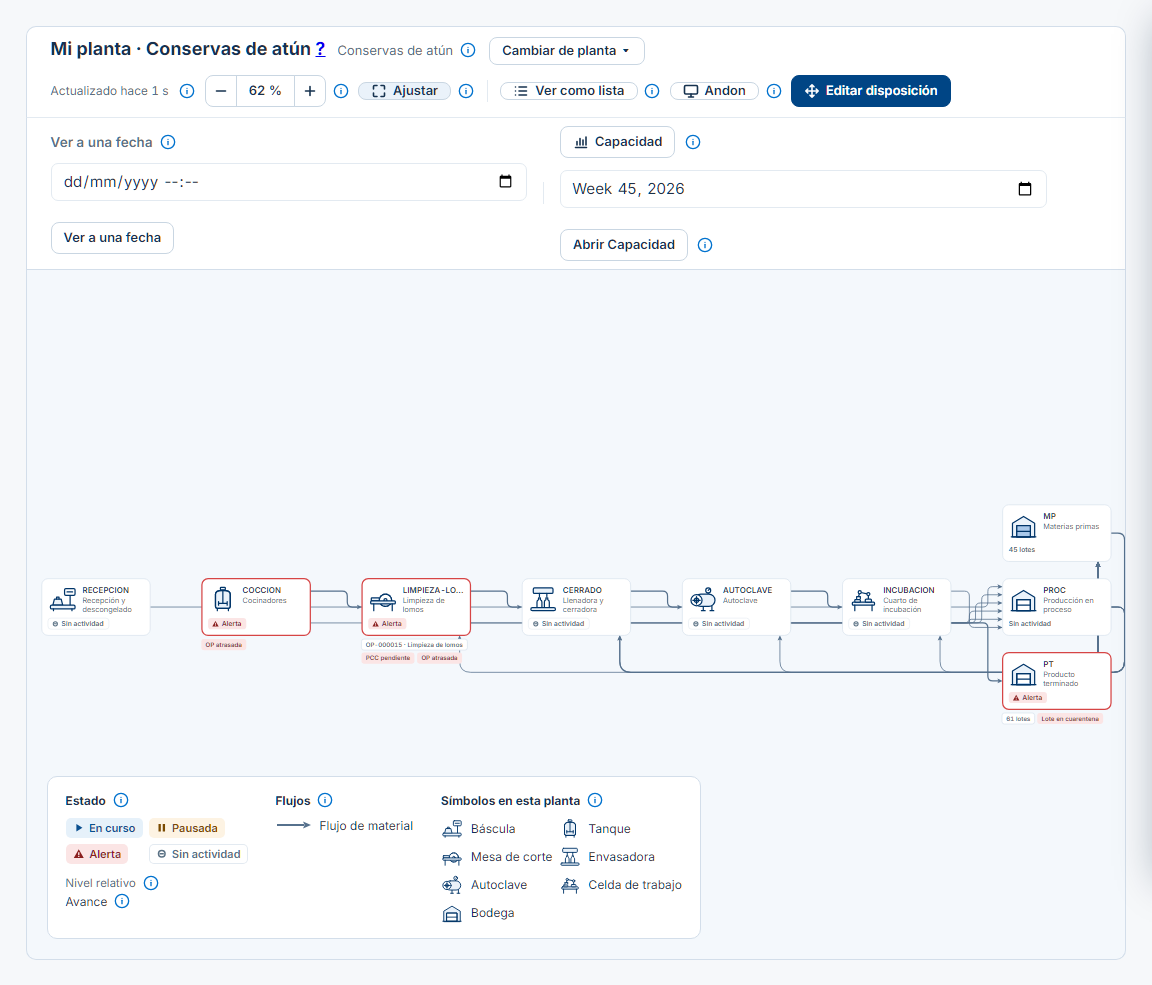
My plant draws the pack's plant: intake and thawing, cookers, loin cleaning, filler and seamer, retort and incubation room. The lot waiting for its commercial sterility shows up in quarantine, and each piece of equipment shows the order it is running and its alerts.

My plant for the canning plant with intake, cookers, loin cleaning, seamer, retort and incubation, each one with its status
From intake to the incubation room in My plant.

What it looks like

Inspection plan of the sterilization critical control point with the minimum F0 and the retort temperature
The sterilization critical control point with its limits.
Rejected inspection with the F0 out of range and the can lot in quarantine
A low F0 holds the can lot.
Nonconformance record with the cause and the corrective action
The nonconformance with cause and treatment.
Preview of a case label with barcode, lot and sanitary registration
The label of the 48-can case.

Frequently asked questions

How do I record the critical control points of each load?

Releasing the canning order creates the cooking, double seam and sterilization inspections. The operator records the values (temperature, F0) at the terminal and signs; every record is kept with date, user and signature, and the monthly report gathers them by lot.

What happens if the F0 falls below the minimum?

The can lot is held automatically, a nonconformance is opened and nobody can ship it until quality releases it after treatment.

How do I handle incubation?

The lot is born in quarantine and the commercial sterility inspection becomes available after the incubation days set in the plan. Only with that inspection approved is the lot released.

Does traceability reach the vessel?

Yes. From a can you reach the retort load, the canning lot, the loin lot and the vessel's receipt with its certificates. If there were tank blends, the system keeps the share of each vessel.

How is the cost split among loin, flakes, meal and oil?

The cleaning recipe classifies loin as the main product, flakes as a co-product by relative sales value and meal and oil as by-products at net realizable value. The order's actual cost is allocated on close.

Can I export the HACCP record?

Yes. The hazard analysis and critical control points (HACCP) record per lot comes out in Excel or PDF with F0, temperature, double seam, compliance and signer, and the lot record in PDF gathers a lot's consumptions, operators and inspections.

See your plant in OpenBusiness

Try the canning pack's demo data, download the brochure or talk to sales and we will show you intake, the critical control points and release with your own figures.

✓ Products and units
✓ Catch intake table
✓ Six work centers and the canning routing