OpenBusiness by Tradebook
Product
Cleaning and facility management

Staffing contracts by site, special services, supplies at cost, AIU and per-worker annex.

SCPEAB
Private security

Staff per post with surcharges, uniforms and PPE with signed records, training with expiry dates.

SCPEFI
Temporary staffing and outsourcing

Workers on assignment, pre-invoice per worker, electronic payroll and PILA costed to the client.

PESCFI
Distribution and consumer goods

Routes and collections with Trade360, inventory movement records per warehouse, filling and packing, catch weight, batch labels.

COABSC
Retail, stores and restaurants

Point of sale with electronic POS document, online store, marketplaces and inventory.

COABFI
Importers and trading companies

Import and export checklists, import declaration costs included in inventory and foreign currency operations.

ABFICO
Manufacturing and industry

Recipes and bills of materials, production orders, actual cost, make-to-order, purchasing and batches.

ABPEFI
Technical service and maintenance

Field work orders with forms and evidence, support with agreed response times and spare parts tracked in inventory.

SCABCO
Government contractors and suppliers

Contracts with Colombia’s SECOP II procurement platform, adjustments based on inflation, minimum wage or tax units, agreed service times, insurance policies and document history.

SCFIPE
Agribusiness

Harvest or livestock intake with weighing, quality and settlement; batches and traceability; field staff.

SCPEAB
Food and beverage

Batch recipes, signed critical control points, traceability to origin, catch weight and harvest settlement.

ABFICO
Chemicals, cleaning products and cosmetics

Percentage formulas with versions, pH and viscosity as critical points, health notification and data sheets.

ABFICO
Recommended suites:COSalesSCServices and ContractsABSupply and ProductionFIFinancePEPeople
Sector pack · Soaps and detergents

Production for soaps and detergents Versioned formulas, a sanitary notification linked to each one and pH control that holds and reworks

The cleaning products pack gets the plant ready: percentage formulas that add up to 100% and scale to the batch size, versions with approval and effective dates linked to the mandatory sanitary notification (NSO), a pH, viscosity and density critical control point that holds the lot and sends it to rework, filling by volume converting kilograms to liters using density, bar soap with glycerin as a co-product and a jug label with lot and NSO number.

Back to Production

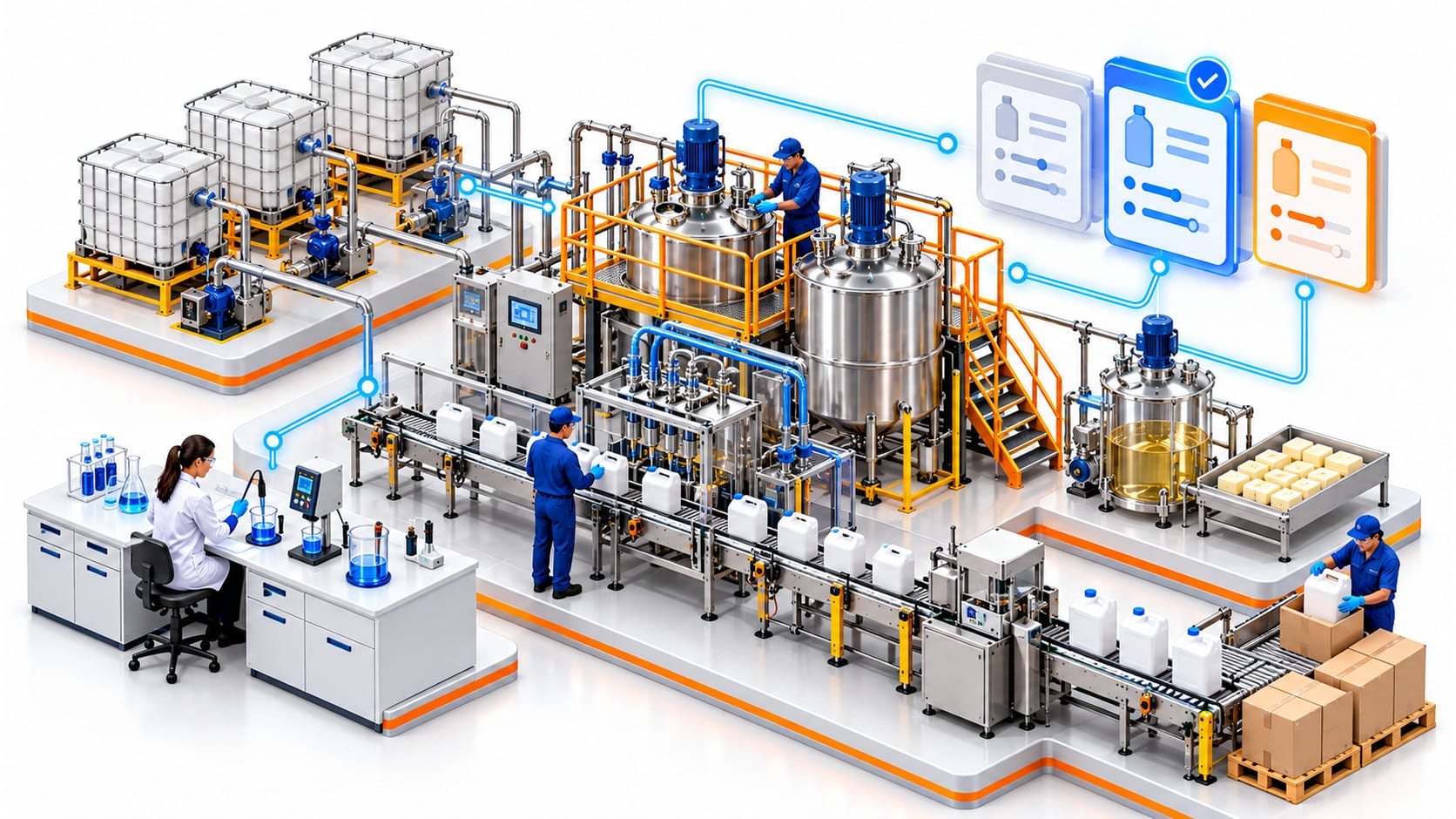
Detergent plant with mixing tank, volumetric filler and labeled 5 liter jugs, and an operator recording the pH on a tablet

Who it is for

  • ✓Manufacturers of liquid detergents, bar soaps and household hygiene products that formulate in percentages.
  • ✓Companies that sell under a mandatory sanitary notification and need the approved formula to match the notified one.
  • ✓Plants that control pH, viscosity and density per lot and need to hold and rework without losing traceability.
  • ✓Fillers that formulate by weight and sell by volume.

The plant's process, step by step

From the chemical raw material to the labeled jug, every step happens on a Production screen and leaves its lot, its cost and its evidence.

  1. Raw material intake

    Demineralized water, sulfonic acid, sodium laureth sulfate, caustic soda, salt, preservative, fragrance and tallow arrive by lot with their certificate of analysis and their safety data sheet (SDS), which are filed in the lot record.

  2. The percentage formula

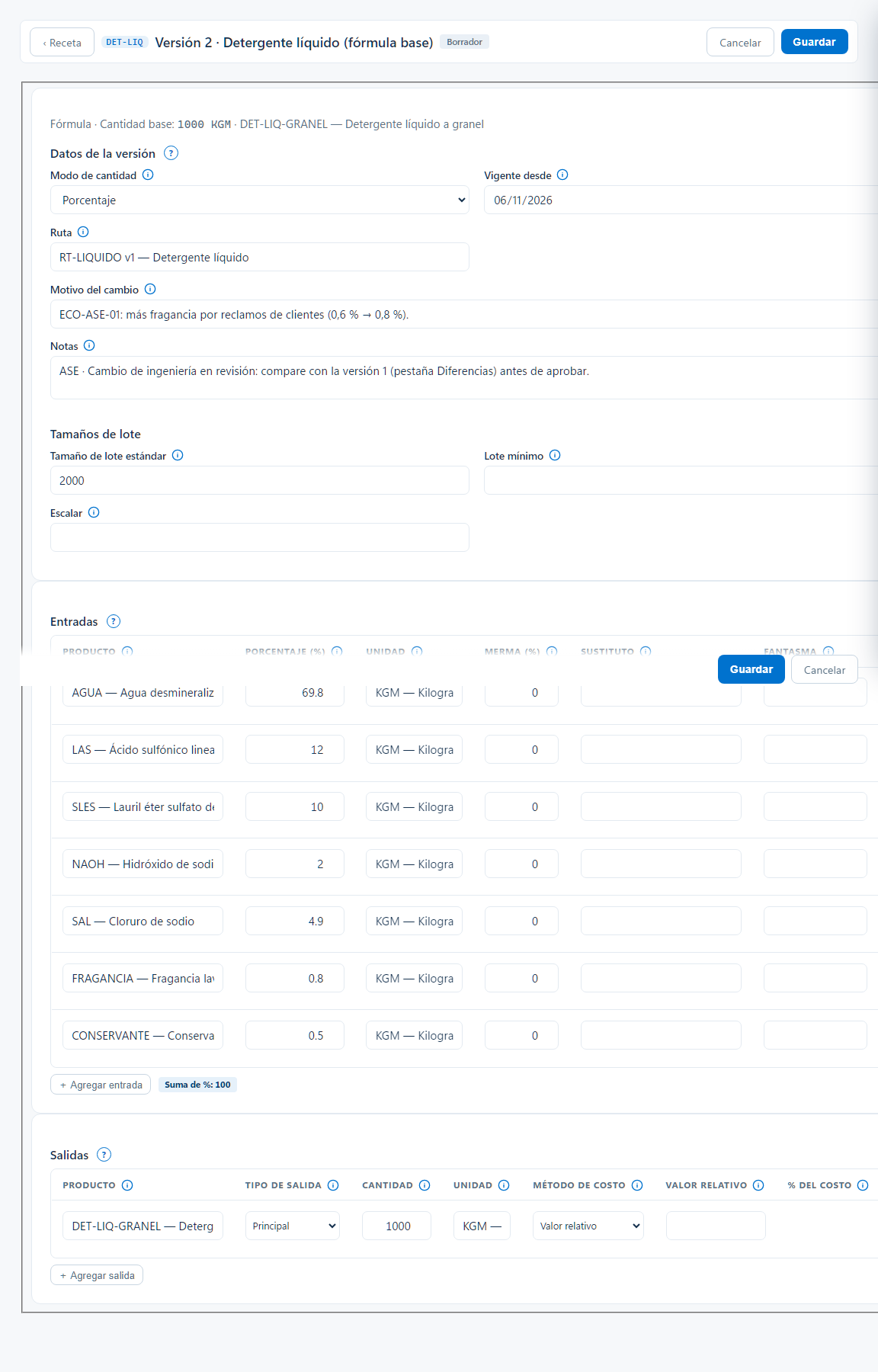
    The liquid detergent is a percentage formula of the base mass: water 70%, sulfonic acid 12% and the remaining ingredients up to 100%. When you ask for 2,000 kg, the system scales every ingredient (1,400 kg of water, 240 kg of sulfonic acid) and respects the tank's batch size.

  3. Versions and sanitary notification

    An active version is never edited. To change the fragrance you create version 2 as a draft, approve it with an effective date and version 1 becomes obsolete; the history says who changed what and when. The sanitary notification is linked to the version: if a version is approved without an NSO covering it, the system does not let you manufacture with it.

  4. Cold mixing or saponification

    The detergent is cold-mixed in the tank; bar soap is saponified in the reactor (tallow, caustic soda and water) and yields soap plus glycerin as a co-product, with separation, drying and stamping. Consumption is recorded by raw material lot.

  5. pH and viscosity critical control point

    Releasing the order creates the critical control point (CCP): pH between 7 and 8.5, viscosity between 800 and 1,500 cP and density between 1.03 and 1.07 kg/L. The operator records the values and signs at the terminal.

  6. Hold and rework

    If the pH reads 9.2, the lot is held and cannot be filled. A rework order takes the held bulk plus citric acid and delivers the corrected bulk; with the pH in range, quality releases it. The original lot stays in the traceability.

  7. Filling by volume

    The filling recipe converts kilograms to liters using density: 1,000 kg at 1.05 kg/L are about 952 liters, that is, 190 jugs of 5 liters. A 2,000 kg filling order yields 380 jugs.

  8. Label and records per lot

    The jug leaves with lot, expiry and the sanitary notification number on the label. The lot record in PDF gathers consumptions, operators, inspections and critical control points, as Decision 706 requires.

What the pack installs

01Fourteen products

Demineralized water, linear sulfonic acid, sodium laureth sulfate, sodium hydroxide, sodium chloride, preservative, citric acid, tallow and oils, fragrance, liquid detergent in bulk and in a 5 L jug, bar soap, crude glycerin and the jug with cap.

02Quality parameters

pH, viscosity, density and active matter, for the critical control point and the finished product inspections.

03Three work centers and three routings

Saponification reactor, cold mixing tank and volumetric filler. Routings for liquid detergent (cold mixing and pH and viscosity control), filling by volume and bar soap (saponification, glycerin separation, drying and stamping).

04Four template recipes

Liquid detergent (percentage formula), filling into 5 L jugs (packaging with density), bar soap with glycerin as a co-product and rework of detergent with pH out of range.

05pH, viscosity and density critical control point

In-process inspection plan with the three ranges; out of range, the lot is held and can be sent to rework.

06Kilograms to liters conversion

The product's density converts the formulated mass into the filled volume, with no side calculations.

07Jug label

Template with barcode, lot, expiry and mandatory sanitary notification number.

08Plant terminology

"Formula", "Revision", "Raw materials" and "Raw material" on the screens, the way your formulator talks.

09Demo NSO

A sanitary notification linked to version 1 of the detergent formula, with its validity, to see how the system requires it when manufacturing and alerts before it expires.

10Demo data

Chemical raw material suppliers, stock and forecast to walk through the full scenario.

Case

Example: a closed lot, a held lot and a canceled one

Figures from the demo company, as they appear on the screens.

70% + 12%water and sulfonic acid in a formula that adds up to 100%
1,000 kgof liquid detergent in a closed order
COP $3,149,959.05actual cost of that order, with materials by lot, labor and overhead
pH 9.2outside the critical control point range: the lot is held and goes to rework
2 versionsof the formula: version 1 active with its NSO and version 2 as a draft, which cannot be manufactured without an NSO covering it

Another batch was canceled for the wrong fragrance: the order was canceled with its reason and the system reversed consumption, output and accounting, leaving every event in the log. Version 2 of the formula, with a different fragrance, is a draft and the history shows who created it; without a sanitary notification covering it, nothing can be manufactured with it.

Regulations it covers, and how

Andean Community Decision 706 of 2008 and Resolution 1370 of 2010: mandatory sanitary notification

Sell only under a valid NSO (the mandatory sanitary notification), with a label that carries lot, NSO, holder, net content and warnings, and records per lot. The NSO is kept with its 7-year validity, linked to the product and to the formula version, printed on the label, and the system alerts before it expires; with registration control on, an order with a version without an NSO is blocked.

Decree 1496 of 2018: globally harmonized system

Labels with a signal word and hazard statements. The label template accepts free text for the hazard and warning statements next to the lot and the NSO.

Resolution 773 of 2021: safety data sheets

A safety data sheet in Spanish for every substance. The sheets are filed as documents of the raw material lot in the record, together with the supplier's certificate.

Records per lot

The lot record in PDF gathers consumptions by raw material lot, operators, inspections and signed critical control points, and traceability reaches from the jug to every raw material lot.

Connected with the rest of OpenBusiness

The formula, quality control and filling touch purchasing, inventory, quality, accounting and sales without anyone typing twice.

  • ✓Raw material lots enter with their certificate and their safety data sheet in the record, in Document management.
  • ✓The held lot is visible on the Inventory lot card with its quality strip, and nobody can fill or ship it.
  • ✓Material requirements planning (MRP) takes the jug orders and the forecast and proposes when to mix and how much sulfonic acid to buy.
  • ✓Every order, rework included, leaves its consumption, labor, overhead and completion in accounting; cancellation reverses everything with its reason.
  • ✓The soap cost is allocated between the bar and the glycerin according to the recipe's rule.
  • ✓An automation flow holds the lot and alerts quality when the pH goes out of range, and another alerts 60 days before the sanitary notification expires.

Your plant at a glance

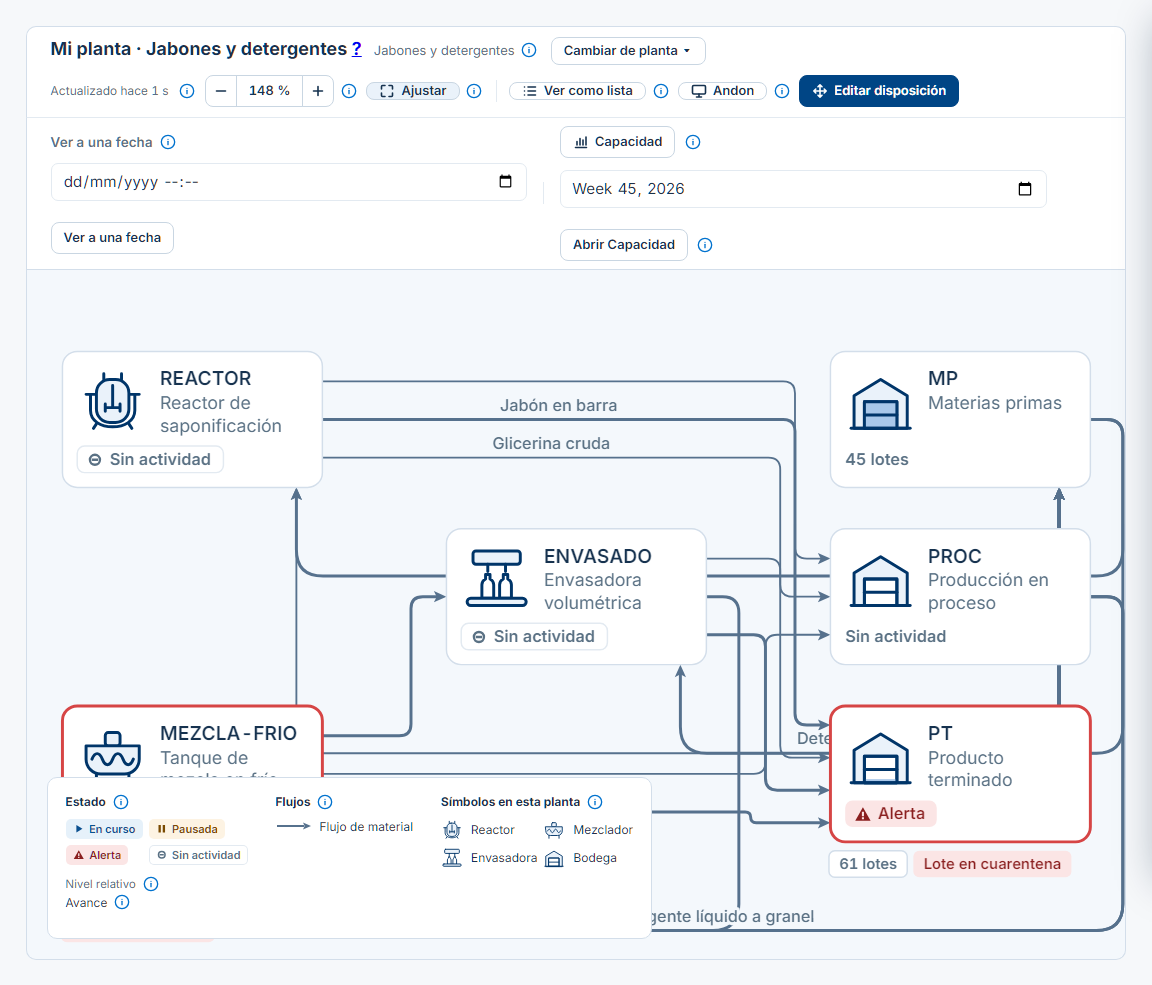
My plant draws the plant from the pack: the saponification reactor, the cold-mix tank and the volumetric filler, linked by the path of the bulk product. Each tank shows the order it is running and its progress, and a lot on hold or an unrecorded control point is flagged as an alert with its cause.

My plant for the cleaning products plant with the saponification reactor, the cold-mix tank and the filler, each one with its status
Reactor, cold mixing and filling in My plant, with their status.

What it looks like

Editing a percentage formula version with water, sulfonic acid and the remaining ingredients
The percentage formula, with 100% validation.
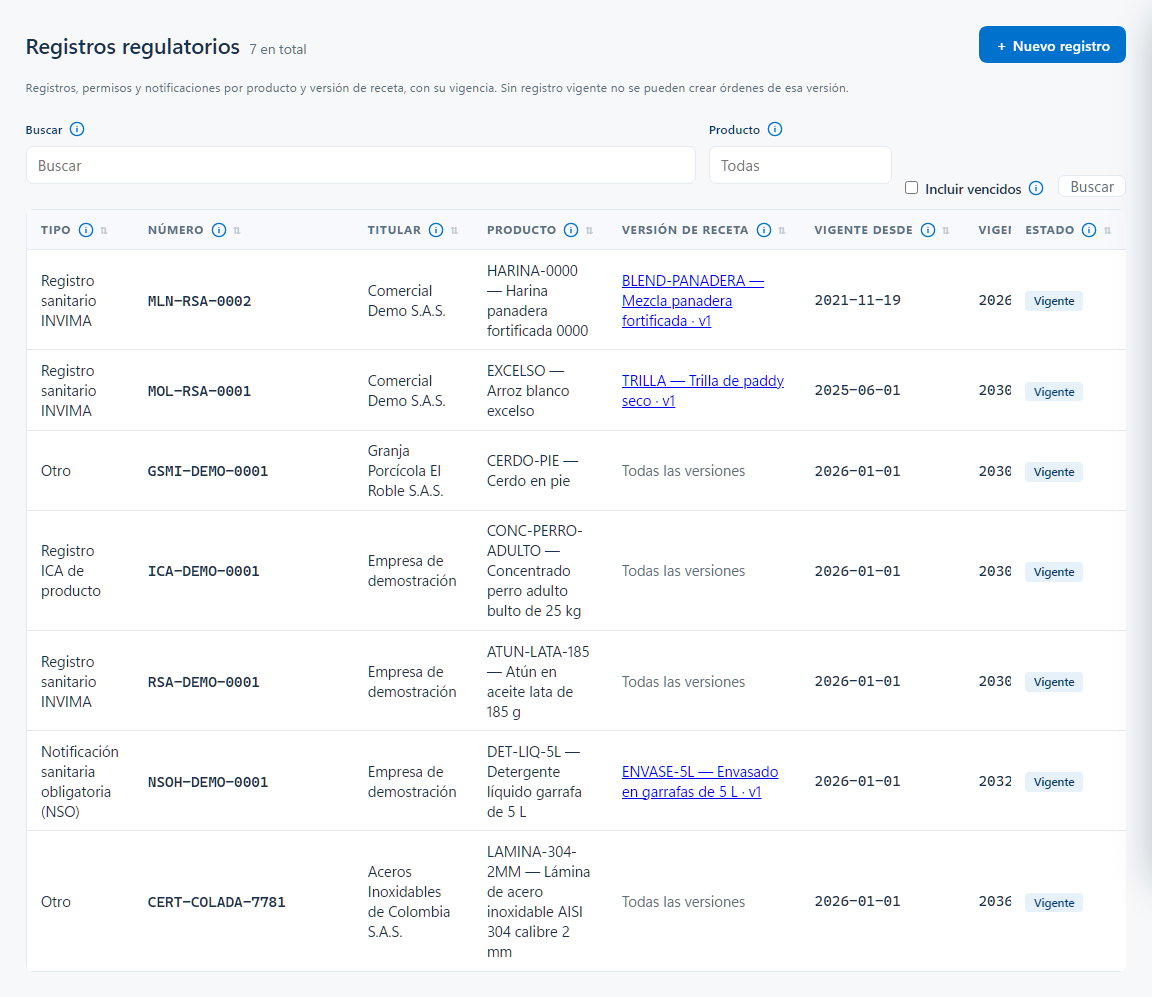
List of regulatory registrations with the sanitary notification linked to the product and its validity
The sanitary notification with its validity and its formula version.
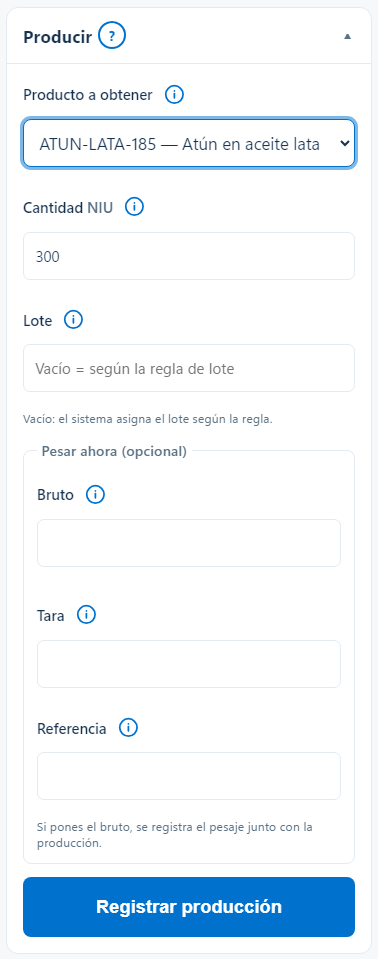
Shop-floor terminal on a phone with the pH and viscosity critical control point to be recorded
The pH and viscosity critical control point on the operator's phone.
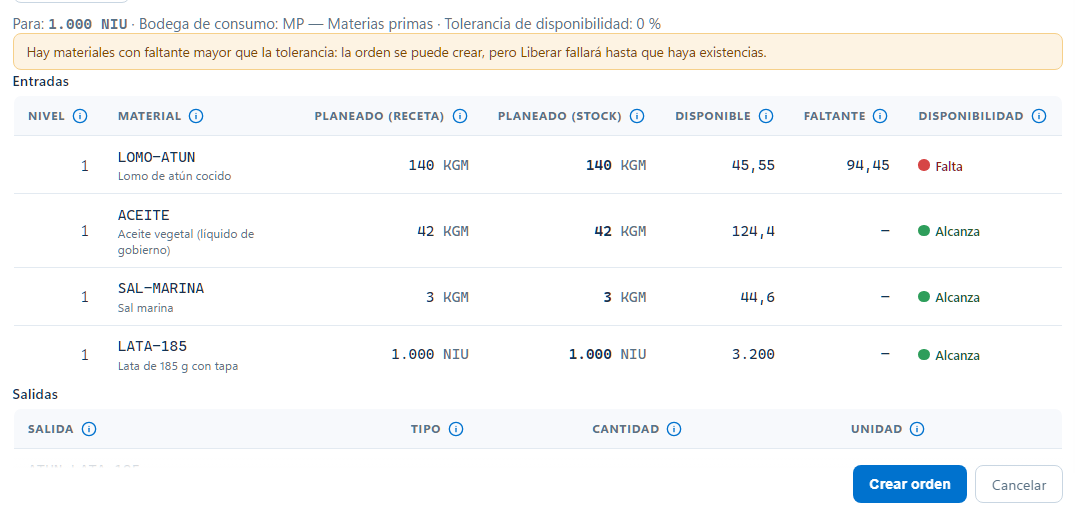
Material availability indicator before creating an order
Before creating the order, the material availability indicator.

Frequently asked questions

How do I change a formula without losing the previous one?

Create a new version as a draft, edit it, approve it with an effective date and the previous one becomes obsolete. The history keeps who changed what and when, and every order says which version it was made with.

How is the sanitary notification linked to the formula?

The NSO registration (the mandatory sanitary notification) is created with its number, holder and validity and tied to the product and the recipe version. With registration control on, an order with an uncovered version is blocked, and the system alerts before the NSO expires.

What happens if the pH is out of range?

The lot is held automatically. A rework order takes the held bulk plus the corrector and delivers the corrected bulk; with the pH in range and quality's signature, it is released.

How do I convert kilograms to liters for filling?

Every product has its density and the system converts the formulated mass into the filled volume. The filling recipe says how many jugs come out of each batch.

How is the soap's glycerin costed?

The bar soap recipe declares glycerin as a co-product with its allocation rule; on closing the order, the actual cost is allocated between the bar and the glycerin.

Does the label carry the hazard warnings?

The label template prints lot, expiry, NSO number (the mandatory sanitary notification), barcode and free text for the signal word and the hazard statements.

See your plant in OpenBusiness

Try the cleaning products pack's demo data, download the brochure or talk to sales and we will show you the formula, pH control and filling with your own figures.

✓ Fourteen products
✓ Quality parameters
✓ Three work centers and three routings