Quote, invoice with DIAN, sell online and chat on WhatsApp from a single customer record.
SCServices and ContractsOperations manager · Deliver and billQuote with margin, run orders at actual cost, sign contracts and serve in the field.
ABSupply and ProductionPurchasing / logistics / plant · Source and produceManage purchasing, inventory, imports and production, with lot tracking, quality control and actual cost per order.
FIFinanceAccounting / financial management · Balance the booksEvery operation is reflected in your accounts. Manage taxes, banks, assets and period closing.
PEPeopleHuman resources · Care for the teamElectronic payroll and social security contributions, signed uniform deliveries and tracking of valid courses and certificates.
PLPlatformIT / management · Included with every purchaseAutomate tasks, ask your AI assistant, connect other applications and control access and changes.
Staffing contracts by site, special services, supplies at cost, AIU and per-worker annex.
SCPEABPrivate securityStaff per post with surcharges, uniforms and PPE with signed records, training with expiry dates.
SCPEFITemporary staffing and outsourcingWorkers on assignment, pre-invoice per worker, electronic payroll and PILA costed to the client.
PESCFIDistribution and consumer goodsRoutes and collections with Trade360, inventory movement records per warehouse, filling and packing, catch weight, batch labels.
COABSCRetail, stores and restaurantsPoint of sale with electronic POS document, online store, marketplaces and inventory.
COABFIImporters and trading companiesImport and export checklists, import declaration costs included in inventory and foreign currency operations.
ABFICOManufacturing and industryRecipes and bills of materials, production orders, actual cost, make-to-order, purchasing and batches.
ABPEFITechnical service and maintenanceField work orders with forms and evidence, support with agreed response times and spare parts tracked in inventory.
SCABCOGovernment contractors and suppliersContracts with Colombia’s SECOP II procurement platform, adjustments based on inflation, minimum wage or tax units, agreed service times, insurance policies and document history.
SCFIPEAgribusinessHarvest or livestock intake with weighing, quality and settlement; batches and traceability; field staff.
SCPEABFood and beverageBatch recipes, signed critical control points, traceability to origin, catch weight and harvest settlement.
ABFICOChemicals, cleaning products and cosmeticsPercentage formulas with versions, pH and viscosity as critical points, health notification and data sheets.
ABFICOThe milling pack gets the mill ready: wheat intake with its analysis, tempering, milling as a breakdown into flour, bran and shorts with cost allocation, bakery blends to specification with fortification as a critical control point signed by quality, a fortification record per lot ready to file, material requirements planning and a milling sequence that groups whole-wheat and white flour to save changeovers.
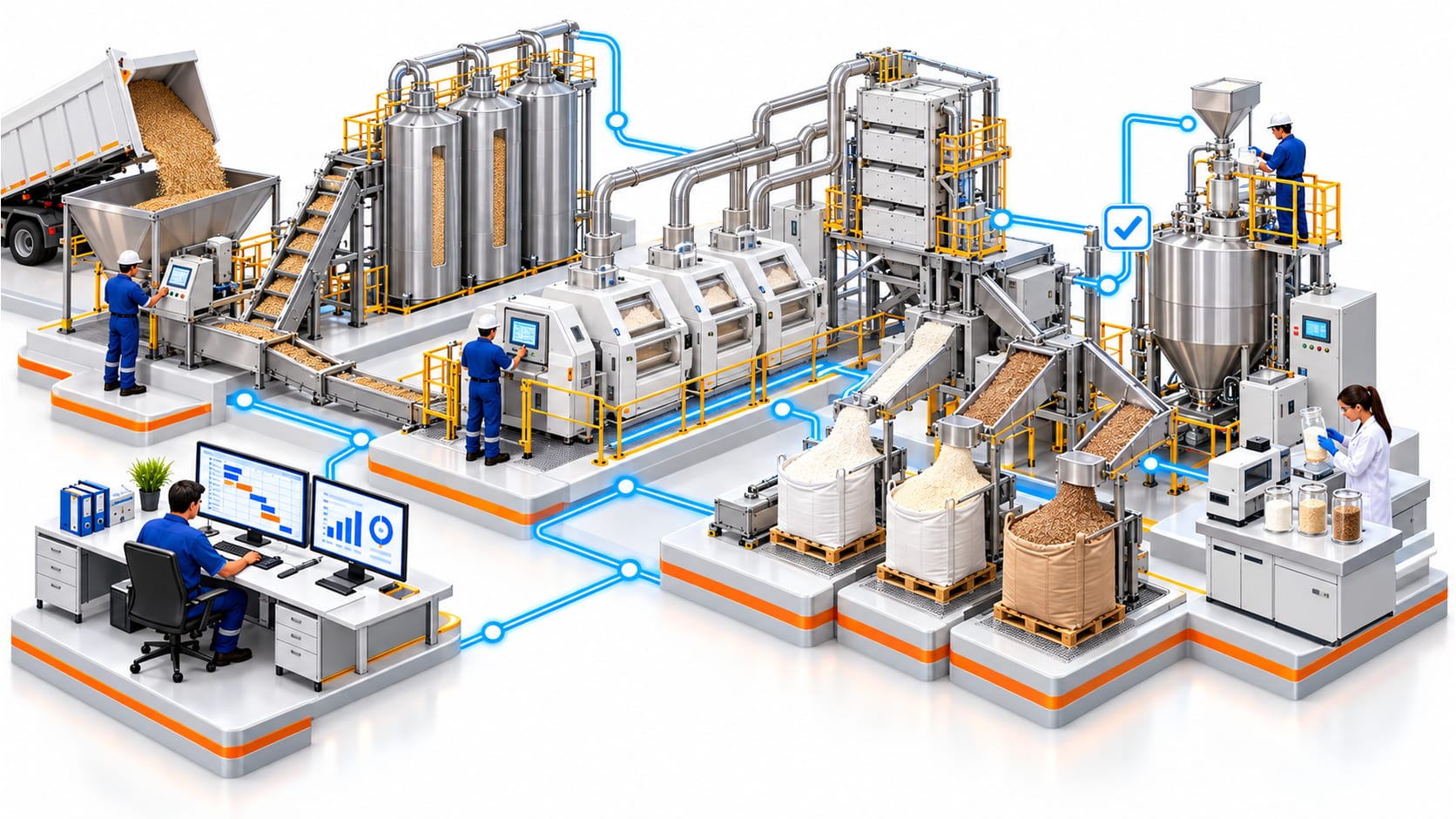
From grain to sack, every step happens on a Production screen and leaves its lot, its cost and its evidence.
Wheat arrives by ship or under contract. The receipt weighs it, and the lab analyzes moisture, protein, test weight and falling number against the wheat quality table. The lot enters the silo in quarantine until the analysis is approved.
Several receipts are consolidated into a silo lot that keeps the share of each one. That way, the traceability of a sack of flour reaches each receipt and its supplier.
The milling routing starts with grain cleaning and tempering, modeled as a 12-hour wait while the grain rests with water up to 15 to 16% moisture.
The milling recipe is a breakdown: from 1,000 kg of wheat come flour 74% (main product), bran 18% and shorts 6% (by-products) and a 2% loss. There is a second recipe for whole-wheat flour (92% flour and 6% shorts). The cost is allocated and the by-products do not inflate the flour.
The bakery blend is a percentage formula that adds up to 100%: flour plus a 0.25% vitamin and iron premix. Releasing the blend order creates the inspections for the fortification critical control point (CCP).
Quality records the milligrams per kilogram of thiamine, riboflavin, niacin, folic acid and iron against the allowed range, and signs. An out-of-range value holds the lot; once corrected and signed, it is released.
Flour leaves in 50 kg sacks or in bulk, with a sack label that carries product, lot and expiry.
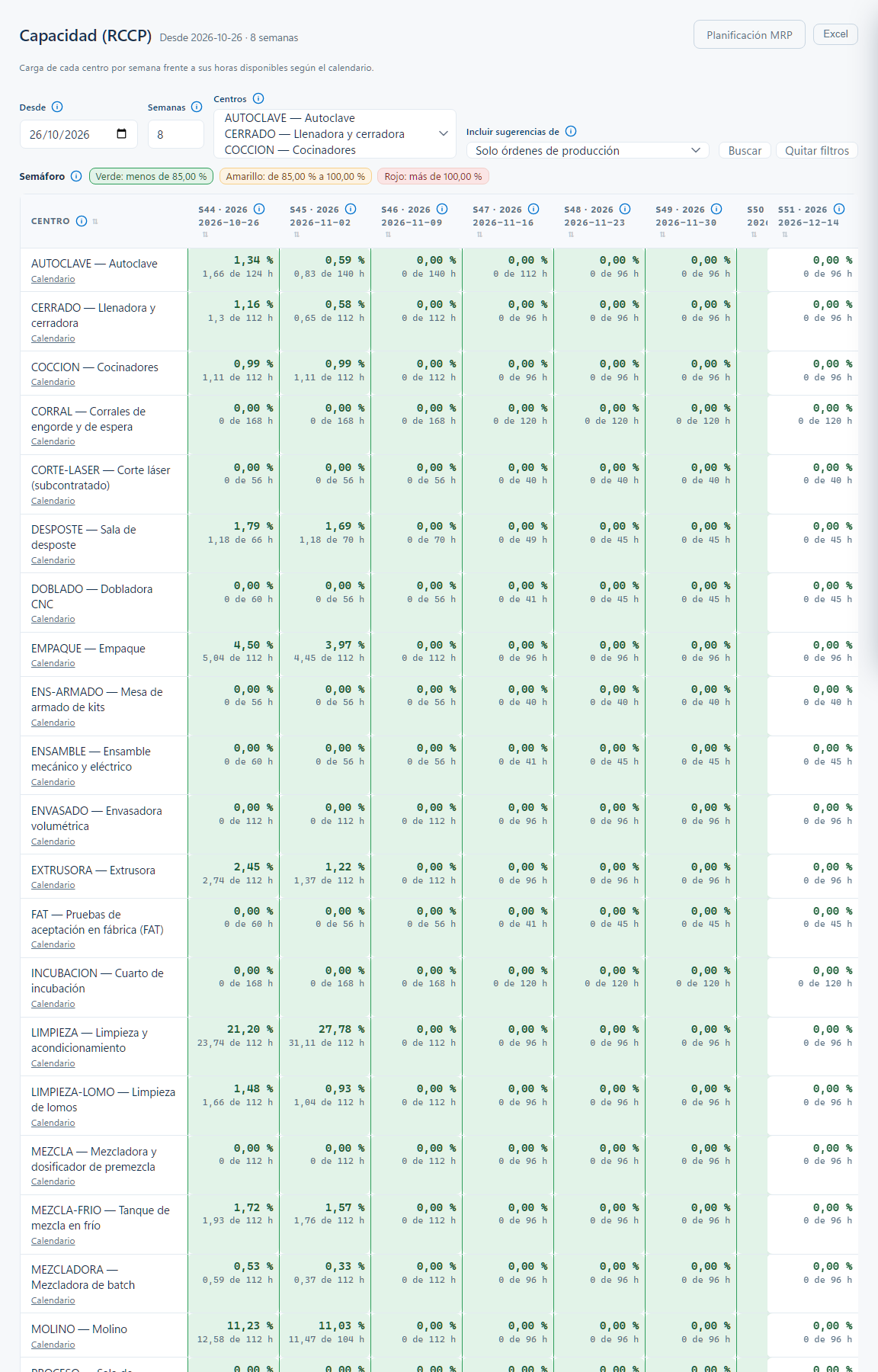
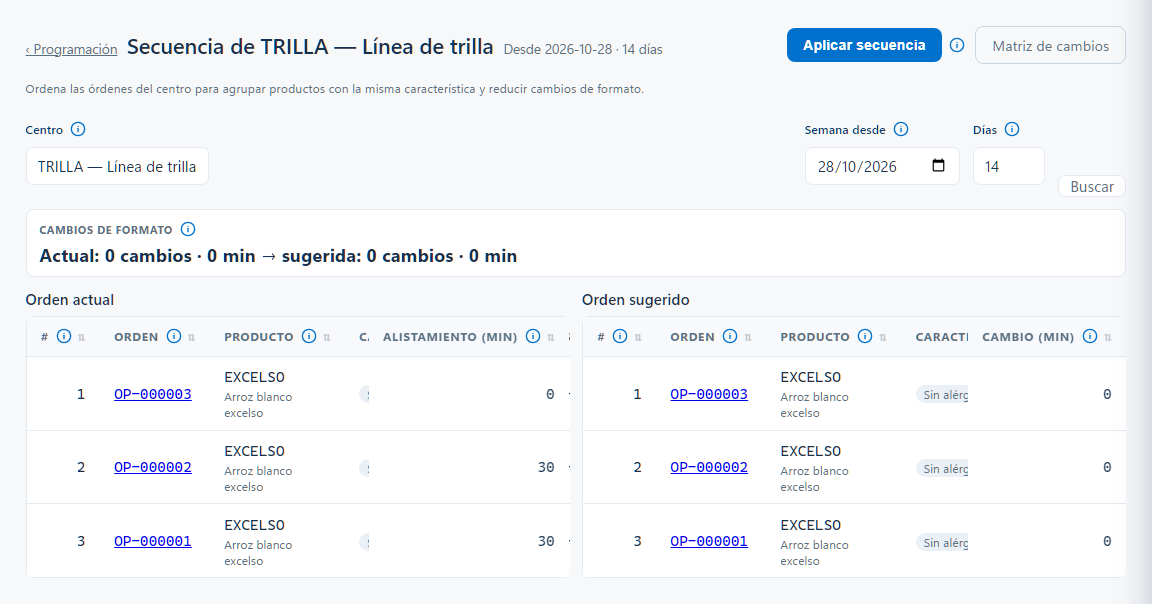
Material requirements planning (MRP) suggests buying wheat at the reorder point and making flour from the forecast. At the mill, sequencing groups whole-wheat and white: switching from whole-wheat to white costs 45 minutes of sifter cleaning and from white to whole-wheat 20, and they are paid only once.
From a received wheat lot, the recall simulation shows which flour, bran and shorts lots it reached and which customers they were shipped to. It is saved as evidence in Excel or PDF.
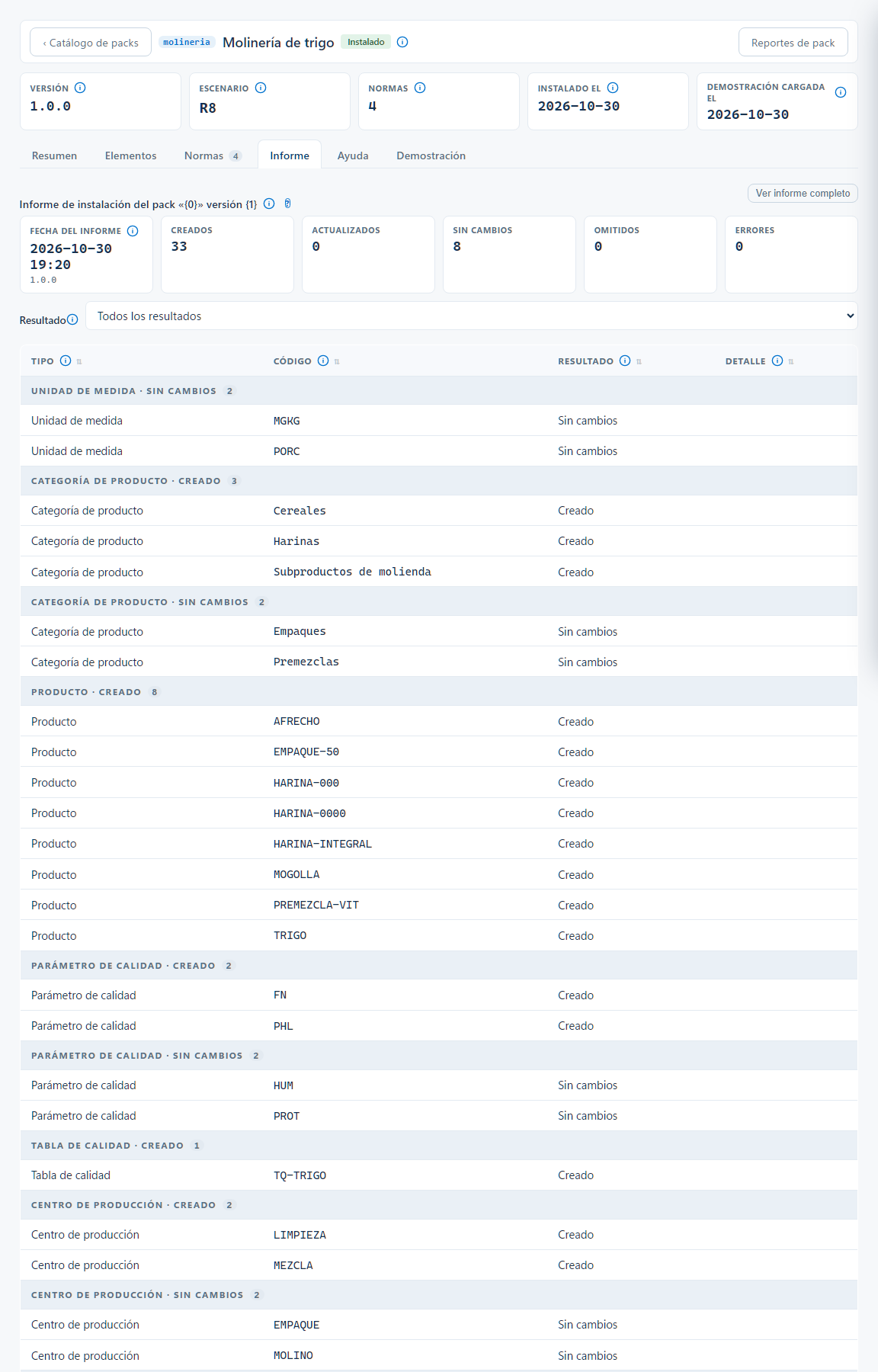
Bread wheat, 000 flour, fortified 0000 bakery flour, whole-wheat flour, bran, shorts, vitamin and iron premix and the 50 kg sack, with their units and categories.
Parameters for moisture, protein, test weight and falling number. The table adjusts the weight for moisture on a dry basis and deducts or pays a bonus for protein and test weight; the mill edits the ranges without programming.
Cleaning and tempering, mill, blender with premix feeder and packaging. Two routings: milling (cleaning, tempering, milling, sifting, packaging) and blending and fortification (blending with critical control point, and packaging).
White flour milling and whole-wheat flour milling (breakdown with by-products) and fortified bakery blend (percentage formula).
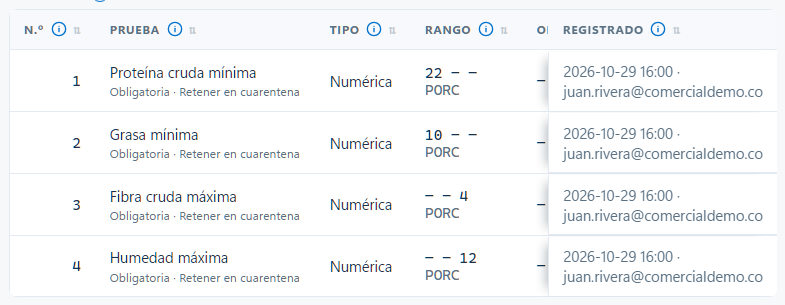
Inspection plan with the five nutrients of Decree 1944 of 1996 (thiamine, riboflavin, niacin, folic acid and iron) with a minimum and maximum per kilogram and the signature of the quality manager.
Monthly report with lot, product, date, each nutrient, whether it complies and who signed, in Excel or PDF, ready to present in an audit.
Changeover minutes at the mill between whole-wheat and white, so that sequencing groups the jobs and the Gantt schedules them.
Four ready-made rules, for example wheat with a 60,000 kg reorder point, so that material requirements planning proposes purchases on time.
"Blend formula", "Consolidate in silo" and "Silo lot" on the screens.
Domestic and imported wheat suppliers, silo stock and a flour forecast to walk through the full scenario.
Figures from the demo company, as they appear on the screens.
In the same month, the material requirements planning run created a planned order for 8,000 kg of flour from the forecast and a wheat purchase order at the reorder point; a sanitary registration expiring in 20 days has already raised its alert; and the recall drill on the received wheat showed the flour, bran and shorts lots affected.
Per kilogram of flour: thiamine 6 mg, riboflavin 4 mg, niacin 55 mg, folic acid 1.54 mg and iron 44 mg. The fortification critical control point checks each nutrient within its range, and the fortification record per lot is generated in Excel or PDF to be filed.
Flours are medium risk and carry an INVIMA sanitary permit (INVIMA is the health regulator). The registration is kept with its validity, linked to the product and to the formula version, and the system alerts before it expires.
Production records and lot control: an change history protected against tampering of every order, a lot record in PDF and traceability of the sack back to the wheat lot and the premix.
Applies if bran or shorts are sold as raw material for animal feed (ICA is Colombia's agricultural authority); the by-products keep their lot and cost to document the sale.
The mill does not work in isolation: planning takes the sales orders, purchases come from the suggestions and every milling run leaves its accounting record.
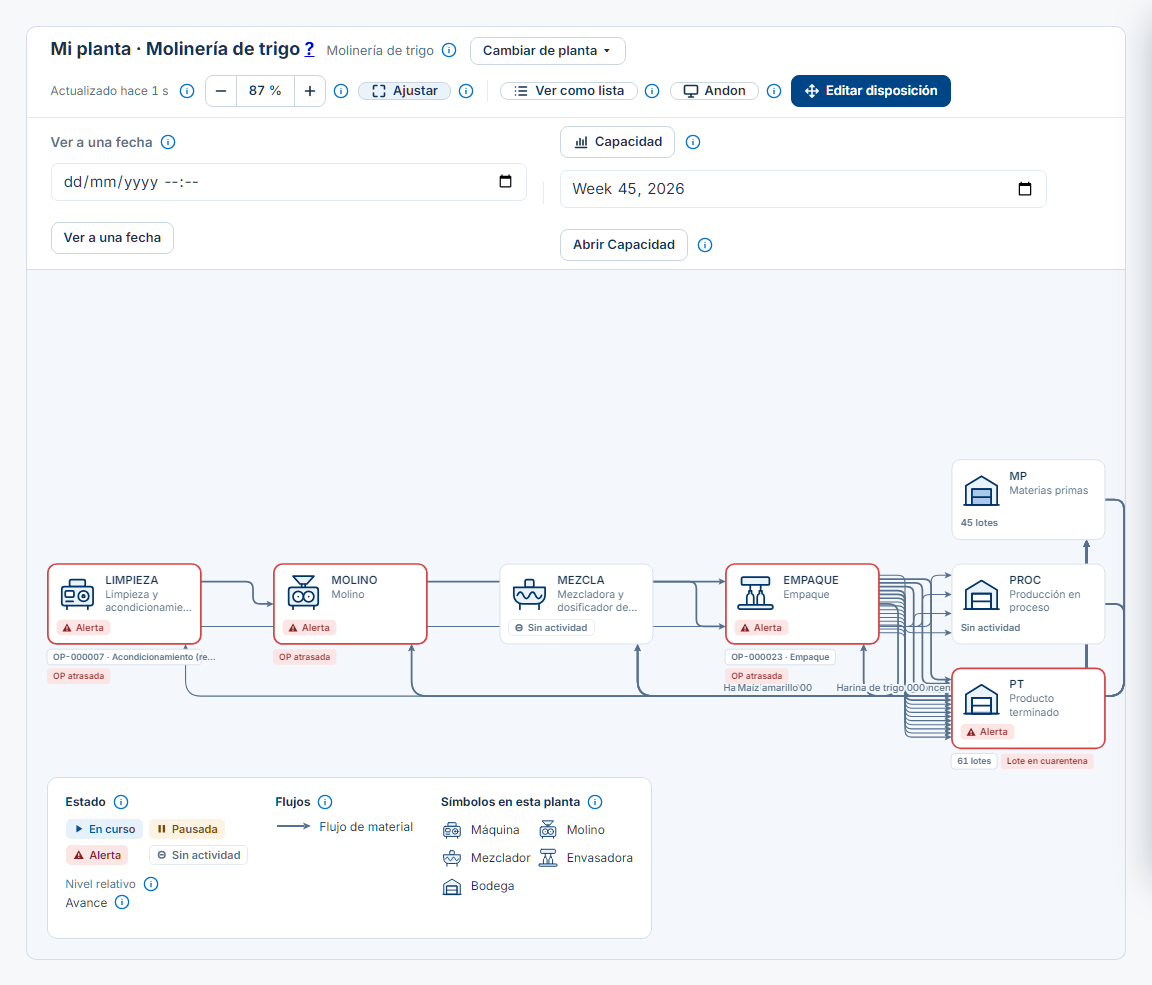
My plant draws the pack's mill: cleaning and tempering, the mill, the mixer with premix dosing and packaging, with the warehouses the wheat moves through. Each piece of equipment shows the running order and how far along it is, and a lot held at fortification is flagged as an alert.


Every blend order generates an inspection of the fortification critical control point with the five nutrients and the signature of the person responsible. The fortification record per lot gathers lot, date, values, compliance and signer, in Excel or PDF.
The lot is held and nobody can consume or ship it. It is corrected, the measurement is repeated and, with quality's signature, it is released.
The milling recipe classifies flour as the main product and bran and shorts as by-products, with their allocation rule by relative sales value, percentage, weight or net realizable value. The order's actual cost is allocated on close.
Yes. There is a recipe for each, and the mill's changeover matrix says how many minutes it costs to switch from one to the other. Sequencing groups the jobs so the changeover is paid only once.
With replenishment rules per product (reorder point, minimum, maximum, minimum lot) and the forecast, material requirements planning proposes the purchase with a date and creates it as a draft when you accept it.
Yes. Every milling run leaves its accounting records with the accounts of your business management system, in a queue where your system confirms or rejects them, and the reconciliation balances the month.
Try the milling pack's demo data, download the brochure or talk to sales and we will show you milling, fortification and sequencing with your own figures.